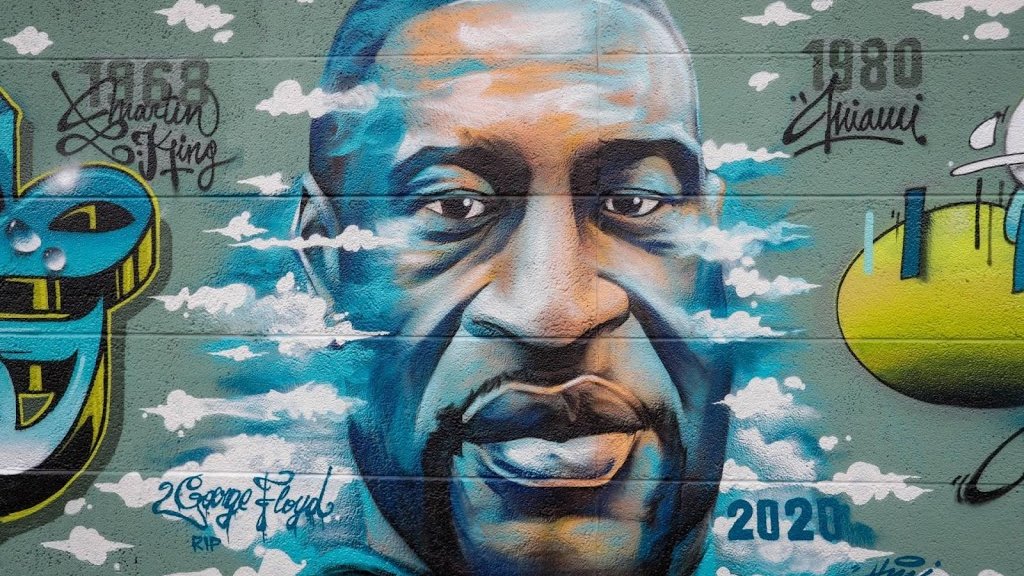
America hasn’t been the same since the day George Floyd was killed by bad policing. Shortly thereafter protests erupted and started to turn into riots. Of course the officer kneeling on Floyd’s neck deserves justice for murder and the officers standing by need to be charged as well. A horrible horrible tragedy. Everyone agreed that this was an act against humanity. The public spoke out against those officers. Police officers from across the country agreed that it was terrible and spoke out against it. Elected officials and the president spoke out against those officers. Everyone agreed that this was to never happen again. Now, the streets have been left with graffiti, looted shops and riots. Cars set on fire and windows busted. Big supermarkets raided and whole communities burnt to the ground. Is this how we will remember George Floyd?
The officer kneeling on Floyd’s neck, Derek Chauvin, has been charged with second-degree murder and manslaughter. That’s how the justice system works. Even his wife divorced him. Justice right? At least that is one of the things that the protestors were demanding: justice for George Floyd. But the protests still carried on. So what is it that needs more justice here? Should Chauvin have been charged with first-degree murder? High profile cases like this usually get charged with higher penalties. Though it appears that the crowd wants something else: justice for the systemic racist police force that have targeted black people for decades. However, as I will try to point out in this post, the biggest issue black Americans are facing right now is not a racist cop. It is not a systemic racist police force. It is the absence of fathers in the black family.
So you could argue that blacks have disproportionally been targeted by racist police officers. Racism isn’t dead and I don’t think it ever will. But to say there is a systemic racist police force then I would have to disagree. Yes, footage of what happened with George Floyd will spark the racial divide even more, but is it really about race? Isn’t it about police brutality in general? Let’s look at it this way: have you heard of Tony Timpa or Kelly Thomas? Have you heard of Daniel Shaver? Or other cases where no police officers were involved such as a black man repeatedly hitting an old white man in an elderly care home? Or have you heard of the special-needs teen who was tortured by 4 black teenagers? If you haven’t then I don’t blame you, because the media will never run their headlines with ‘cops killed a white man’ or ‘white man assaulted by black man’ and calling for a stand against racism. These headlines don’t sell. So should we form our opinions on what the media decides to cover? Or should we be looking for evidence of racism? Exactly, we have to look at what the data tell us.
Racist police conduct?
There are a few things to point out before we head into analyzing the statistics and one of it is the supposed theory behind the idea of systemic racism. If systemic racism within the racist police force is genuinely a thing, you would state something like: blacks have been killed disproportionally more by police officers than whites have. However, it’s not that easy to prove. We would have to take into account that black people make up around 12 percent of the population against the 62 percent of the people that are white. Then again, more than 50% of the homicide is committed by black people, so you would assume there would be relatively more hostile encounters between black people and the police. In other words: racial disparity does not automatically equal racial bias. Also worth noting: being shot by the police unarmed does not always mean it was unjust. Some of the people who were shot unarmed were reaching for the officers gun. So the real question here is: whether a black person is significantly more likely to be unjustly killed in an interaction with the police than a white person. If we take all of this into account we should be able to figure out whether blacks indeed have been disproportionally racially targeted by the police. So let’s have a look at the data.


According to a report from the Bureau of Justice Statistics (2019) on criminal victimization from the year 2018, Table 14 shows us the staggering difference between crimes committed by and on certain races. These are interracial violent crime incidents between citizens where the police have had no role in them at all. As we can see, the largest percentage of violent incidents were committed by someone of the same race. In fact the percentage of violent incidents involving white (66%) and black (11%) victims (Table 12) was similar to the population percentages of white (62%) and black (12%) persons.
“…you cannot have an honest discussion about police conduct without an honest discussion of black crime.”
Larry Elder
When looking at the victims’ perception of the offenders, the offender-to-population ratio shows that the percentage of violent incidents involving black offenders (22%) was 1.8 times the percentage of black persons (12%) in the population. In contrast, the percentage of violent incidents involving white (50%) offenders was about four-fifths (0.8 times) the percentage of whites (62%) in the population. This shows that blacks are disproportionally involved in violent incidents when it comes to the offence of the crime compared to whites. Larry Elder, an author and talk show host cites a 2013 Justice Department study of racial profiling: “Numerical disparities result from differences of offending, not because of racism.” He concludes: “You can not have an honest discussion about police conduct without an honest discussion of black crime.” That is the reason why we have to go through all the numbers.
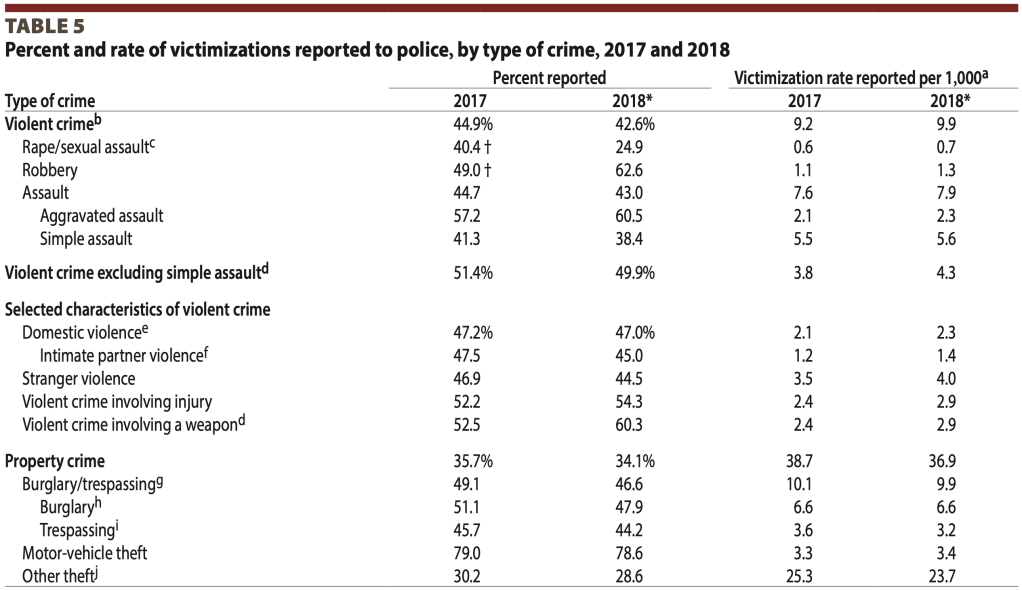
The report also shows in Table 5 that less than half of these incidents are reported to the police and if a certain group is over- or underrepresented in the data, it’s a problem. However, these reports can prove to be useful when compared to data that actually is reported by the police and see if the numbers check out. To do this we use data from the FBI on reported arrests by race and ethnicity. According to this report the percentage of total arrests involved 54% white people and 27% black people. The criminal victimization report showed us that 50% of the violent crime offenders were white against the 22% of black offenders, which is a +4% discrepancy for the violent incidents involving whites and a +5% discrepancy for violent incidents involving blacks. Hostile encounters with the police usually end up with you either being arrested or killed, so we should also be looking at data on civilian deaths by police officers.
When looking at an annually report by the Washington Post on fatal police shootings from 2018, we can see that 992 people were shot and killed by police. 451 of them were white and 229 were black. Again, we could try and combine this data with the FBI crime report and see what the death rate is per violent crime arrests. You could rightly argue that not everyone who was killed by the police was shot to death. Would George Floyd end up in these statistics? Probably not. (If we were to take every deviation into account, we would have to take every case by case and see if the killings were justified. Some have already done this and can be found here.) When combining the data from both sources we come to the following conclusion: for every 9153 white persons that are arrested, 1 is shot and killed. And for every 9237 black persons that are arrested, 1 is shot and killed. Obviously this method is not conclusive and I leave it up to you to decide whether the reports are useful or not, but we’re also unable to verify that there is a direct link to racist police conduct. So if not the police, then what is troubling the black community in America?
Fatherlessness
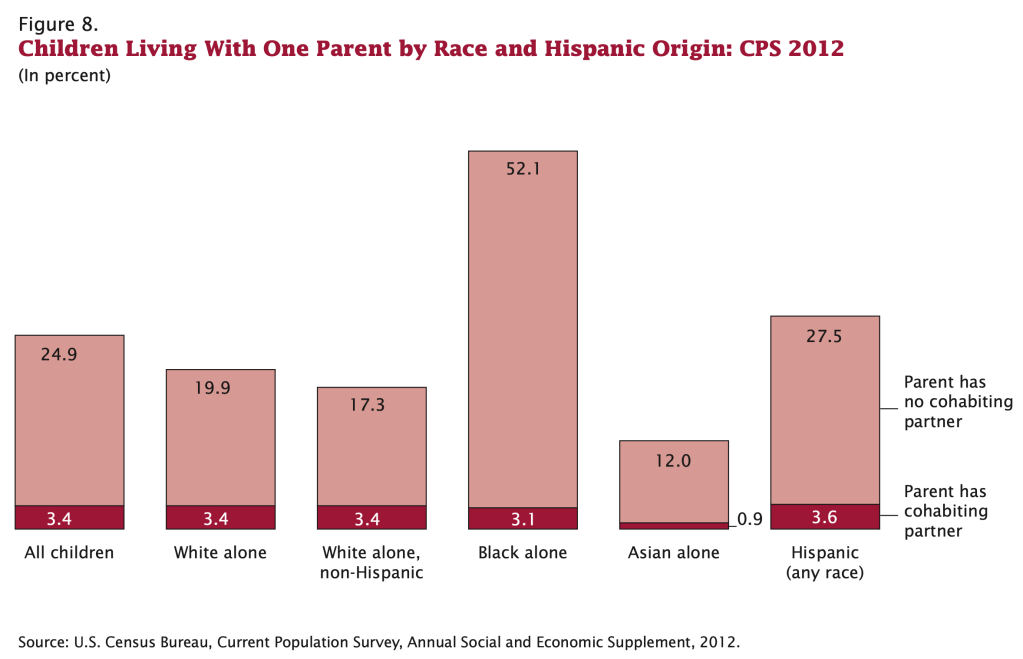
Often when talking about the black community we tend to see the root of all problems in racism and it’s history of slavery, but rarely do we hear about other significant problems. So let’s talk about another issue black people are facing today in America: fatherlessness. It has been pointed out by a study from the Department of Health & Human Services (2012) that the poverty rate among children in female-headed families with no spouse present was 47.6% in 2011, up from a recent low of 42.0% in 2006. This is a poverty rate over four times that of children in married-couple families in 2011 (47.6% compared to 10.9%). When comparing this with figure 8 from the US Census Bureau shown below, we can see that more than half of the black households are single parent households. A link to poverty can then be easily made.
Not only are children more likely to be poor when living in a female-headed family, the physical and emotional health of these children appear to be worse than children growing up in a nuclear family. A study of 1,977 children of age 3 and older living with a residential father or father figure found that children living with married biological parents had significantly fewer externalizing and internalizing behavioral problems than children living with at least one non-biological parent (Hofferth 2006). Even the suicide attempts among adolescents (especially among girls) is almost tripled when a child grows up with only one parent or divorced parents (Chau et al. 2014). And if that isn’t enough, data from the Fragile Families Study was used to examine the prevalence and effects of mothers’ relationship changes between birth and age 3 on their children’s well being. Children born to single mothers show higher levels of aggressive behavior than children born to married mothers. Living in a single-mother household is equivalent to experiencing 5.25 partnership transitions (Osborne & McLanahan 2007).
A non-traditional family structure also leaves a mark on a child’s accomplishments in school. Children who have always lived with their biological parents have a significant academic advantage over children who experienced divorce or a nonunion birth. Divorce/separation is also more detrimental than nonunion birth for college expectations, particularly when coupled with a transition into a stepfamily based on cohabitation (Tillman 2007). A report by the US Department of Education (2001) pointed out that biological mothers in a stepfather family are less likely to be highly involved in their child’s schools than biological mothers in two-biological-parent families. Even biological mothers in a mother-only family are more likely to be highly involved in their child’s schools than biological mothers in a stepfather family. On the other hand, biological fathers in stepmother families are more likely to be highly involved in their children’s schools than fathers in two-biological-families. 35% of students living with a biological father and a stepmother have a father who is highly involved in their schools compared to 28% of students living with both biological parents. Next to this are the fathers in father-only families, where 46% of them are highly involved in their child’s schools. Thus, if improving the academic competence of children in America is your goal, addressing fatherlessness is a good start.
“Children growing up without a father are more likely to drop out of school and wind up in prison. They’re more likely to have substance abuse problems, run away from home, and become teenage parents themselves.”
Barack Obama
Having no father around certainly has its impact on the child, but it’s even more destructive when the children are bound to repeat the cycle. When you’re raised by a single mother it raises the risk of teen pregnancy, marrying with less than a high school degree, and forming a marriage where both partners have less than a high school degree (Teachman 2004). These family conditions are by no means a healthy startpoint for the children, let alone teach them about sex. It is no coincidence then that, following the single-parent rate among black families, the abortion rate among black women is so high (29% of all pregnancies). This is in stark contrast with the abortion rate among white women which count for 10% of all pregnancies.
On June 19th 2009 the weekend of fathers day, then president Barack Obama addressed the issue of absent fathers. He pointed out that: “children growing up without a father are more likely to drop out of school and wind up in prison. They’re more likely to have substance abuse problems, run away from home, and become teenage parents themselves.” How much more likely are we talking about? You’re 9 times more likely to drop out of school, 20 times more likely to end up in jail, 10 times more likely to have chemical substance abuse, and 32 times more likely to run away from home (Williamson 2008). Following the rate of single-parent families among black people, as I mentioned before, it is no surprise why black crime is so high. Shouldn’t it be evident why hostile encounters between black people and the police occur at a higher rate than between white people and the police? Isn’t it clear that all these problems in the black community are connected to fatherlessness?
Themes like police conduct and absence of fathers in the black family have been pointed out by many people in the black community such as: Tommy Sotomayor, Larry Elder, Candace Owens and Brandon Tatum. If you’d like to know more about the subject feel free to check them out. For now, I rest my case here. George Floyd shouldn’t have died. He died by a police officer who might have been a racist, but looking at the numbers, I don’t think there’s a systemic racist police force. Though I would agree that there is a problem with police use of force. Black people are disproportionally being arrested, but they’re also disproportionally overrepresented in the crime statistics. If we want to help black people, we need to be having an honest discussion about fatherlessness within the black community. If you disagree, I’d be happy to have you change my mind. Just remember that not all cops are racist. The same applies to not all blacks being criminals. I hope I was able to address the importance of fathers in our lives and if anything tragic about George Floyd’s death is left to be addressed, is that his children will now grow up without their father.
Chau, K., Kabuth, B., & Chau, N. (2014). “Gender and family disparities in suicide attempt and role of socioeconomic, school, and health-related difficulties in early adolescence”, BioMed research international (2014): 314521.
Demuth, S. & Brown, S. L. (2004). “Family Structure, Family Processes, and Adolescent Delinquency: The Significance of Parental Absence Versus Parental Gender”, Journal of Research in Crime and Delinquency, 41(1) : 58-81.
Hofferth, S. L. (2006). “Residential father family type and child well-being: investment versus selection”, Demography, 43: 53-78.
Morgan, R. E. & Oudekerk, B. A. (2019). Criminal victimization, 2018, Bureau of Justice Statistics.
Osborne, C. & McLanahan, S. (2007). “Partnership instability and child well-being”, Journal of Marriage and Family, 69: 1065-1083.
Teachman, J. D. (2004). “The childhood living arrangements of children and the characteristics of their marriages”, Journal of Family Issues, 25(1), 86-111.
Tillman, K. H. (2007). “Family structure pathways and academic disadvantage among adolescents in stepfamilies”, Journal of Marriage and Family.
U.S. Department of Education (2001). National Center for Education Statistics. Fathers’ and Mothers’ Involvement in Their Children’s Schools by Family Type and Resident Status. Washington DC.
U.S. Department of Health and Human Services (2012): ASEP Issue Brief: Information on Poverty and Income Statistics.
Vespa, J., Lewis, J. M. & Kreider, R. M. (2013). “America’s Families and Living Arrangements: 2012”, Current Population Reports, 20(2013): 570.
Williamson, J. N. (2008). Being Fathered for a Divine Purpose. Xulon Press.
 Ruben on Right